

Throughout the previous works of this journey I find myself on, I have done my best to highlight the fascinating history of photography to better understand and appreciate the art form as we know it in the present. I would be remiss if I did not include an entry for one of the fathers of the art, one whose name has been bandied about many times since I began this endeavor: Louis Daguerre. A man known predominantly for his work in photography, Daguerre’s life didn’t start quite like Joseph Nicephore Niepce or William Henry Fox Talbot. He began his life as an artist, but ended it as a revolutionary inventor.
Born on November 18, 1787, Louis-Jacques-Mandé Daguerre was the first child and only son of Louis Jacques Daguerre and Anne Antoinette Hauterre born in the small town of Cormeilles-en-Parisis within the province of the Kingdom of France (Habert, 2020) (Geneastar, 2024). Shortly after he was born, the family moved to Orléans, the capital of the Kingdom (Habert, 2020). His parents were not wealthy but took note of their son’s artistic abilities and arranged for him to apprentice with the first French panorama painter Pierre Prévost in Paris (Habert, 2020). Under Prévost’s guidance, Daguerre was hired to be a scene painter for the opera (Britannica, 2024). By age 23, in 1810, Daguerre was married to Louise Georgina Arrow-Smith., who was only a year older than her husband (Geneanet, 2024).
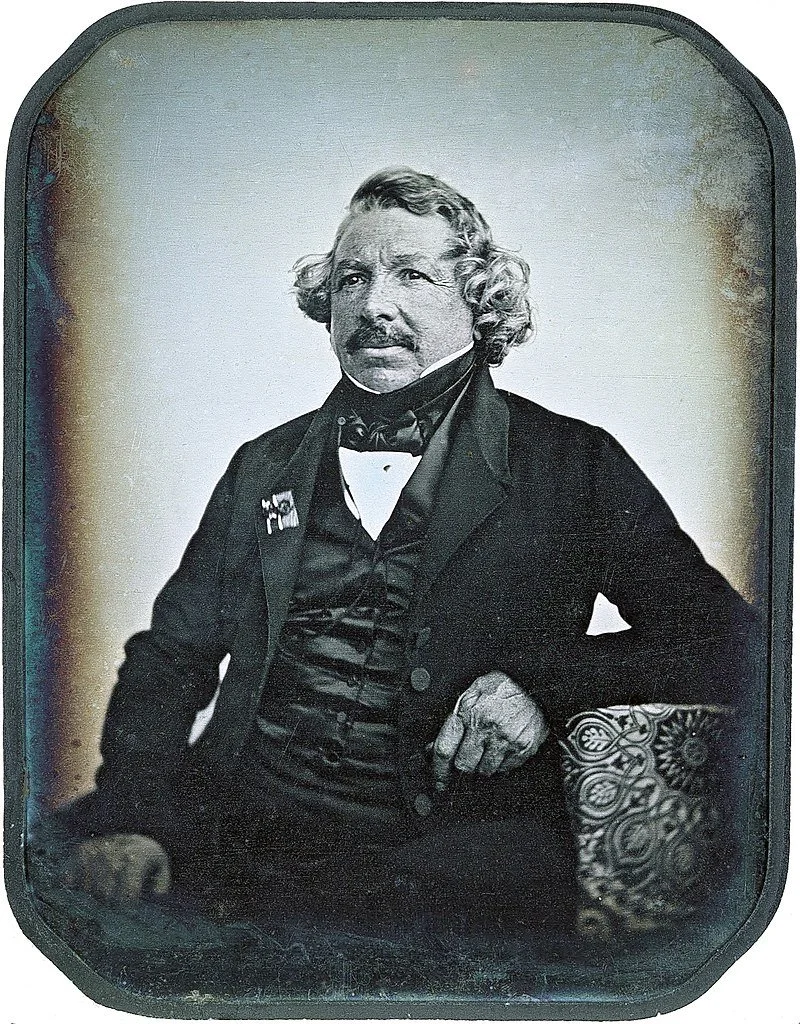
By the year 1822, Daguerre opened an art exhibit of pictorial views that was known as Diorama, with various effects induced by changes in the lighting. A few short years later, however, the direction of his life and legacy would change forever when he learned of the experiments of Joseph Nicéphore Niépce, the creator of the first ever photograph and father of photography, then known as heliography (Britannica, 2024). In 1829, Daguerre and Nicéphore began working together to refine the processes that the latter had already developed. By 1832, the two had fine-tuned the scientific process, although they continued to experiment until the following year (House Museum, 2024). In 1833, Joseph Nicéphore Niépce suffered a stroke and passed away. Despite the loss of his partner, Daguerre persevered with their process, eventually discovering that exposing an iodized silver plate in a camera would result in a lasting image if the latent image on the plate was developed by exposure to fumes of mercury and then fixed (made permanent) by a solution of common salt (Britannica, 2024).
With this development, Daguerre moved towards publishing this discovery. Once he refined and finished the process, in 1837, he brought it to Isidore Niépce, Nicéphore’s son (House Museum 2, 2024). Isidore became Daguerre’s business partner, continuing the legacy of his father’s work. The two developed the actual product, while Daguerre developed the name - the Daguerreotype - and began to pitch their work to investors (House Museum 2, 2024). However, on August 19, 1839, Daguerre and Isidore were granted pensions by the French Parliament, which allowed the two to publish their work (Alfred, 2008). With the publishing of the Daguerreotype’s patents, thus began a rivalry with another pioneer of photography in William Henry Fox Talbot. The begrudged Talbot had attempted to publicize his own scientific papers back in 1835, although he didn’t make public until 1839, likely in response to the Daguerreotype. However, what Talbot was unaware of was Nicéphore’s discovery of the processes Talbot claimed to have invented nearly a decade prior.
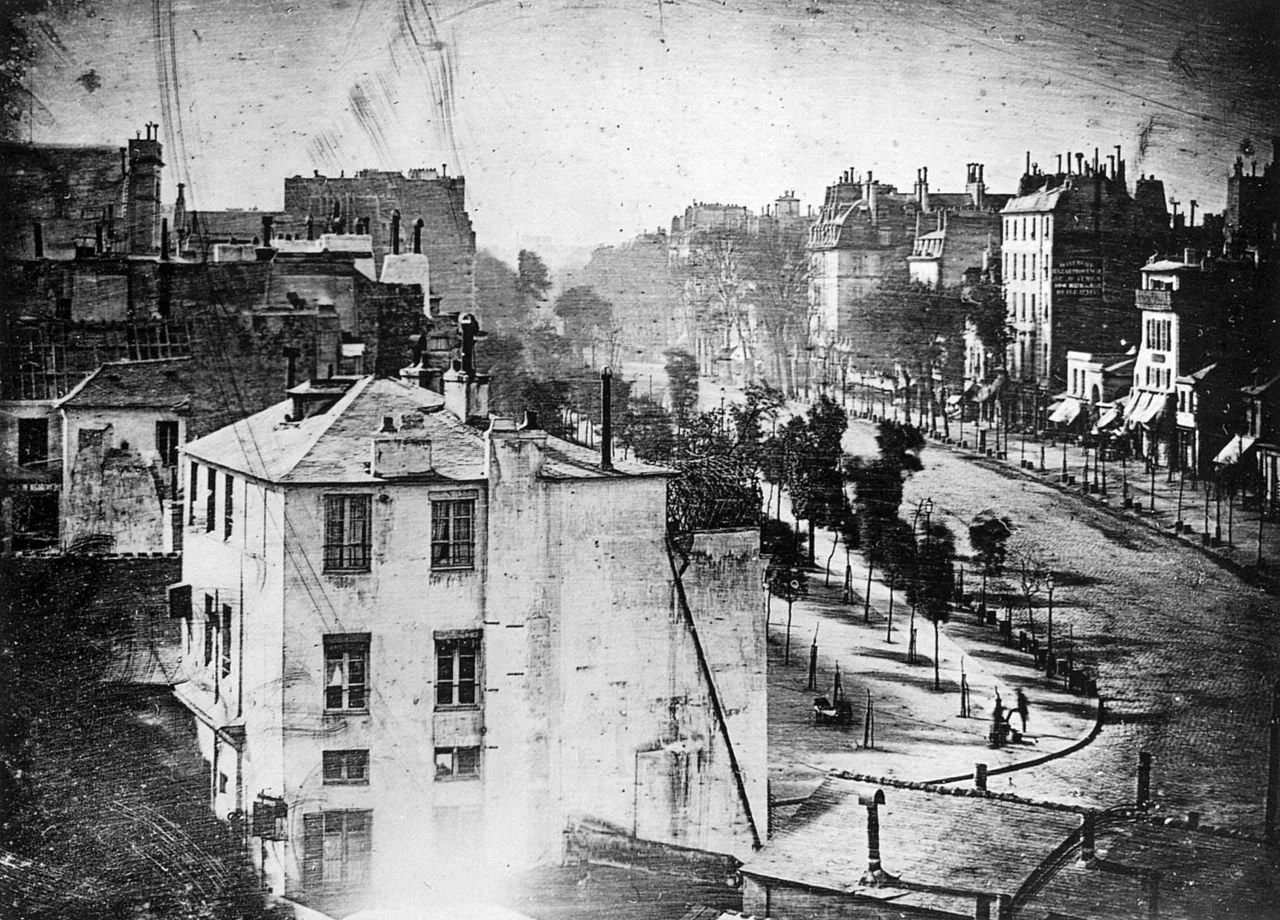
In 1841, Daguerre endured a great deal of hardship from two separate fronts, which dashed his reputation and endangered his profitability. With the Daguerreotype’s success, the unfortunate reality was that Joseph Nicéphore Niépce’s legacy was largely excluded and left obscured from the public. In response to this, Isidore Niépce published a booklet that highlighted his father’s accomplishments and that Daguerre had essentially claimed all credit for himself, despite the major strides of the product being that of Nicéphore (House Museum 2, 2024). Around this time period, Talbot had utilized his own process, one similar to Nicéphore and Daguerre’s to create the Calotype, which then became the direct competitor to the Daguerreotype.
By 1850, Daguerre’s inventions went internationally, making their way to America, where it would be used by many, including Robert Cornelius, who utilized the invention to create the first self-portrait (Habert, 2020). In 1851, Daguerre suffered a heart attack and passed away on July 10th. He was survived by only his wife, Louise, whom he had been married to for over 40 years (Geneanet, 2024). Additionally, his name is one of 72 names that is etched into the Eiffel Tower in Paris.
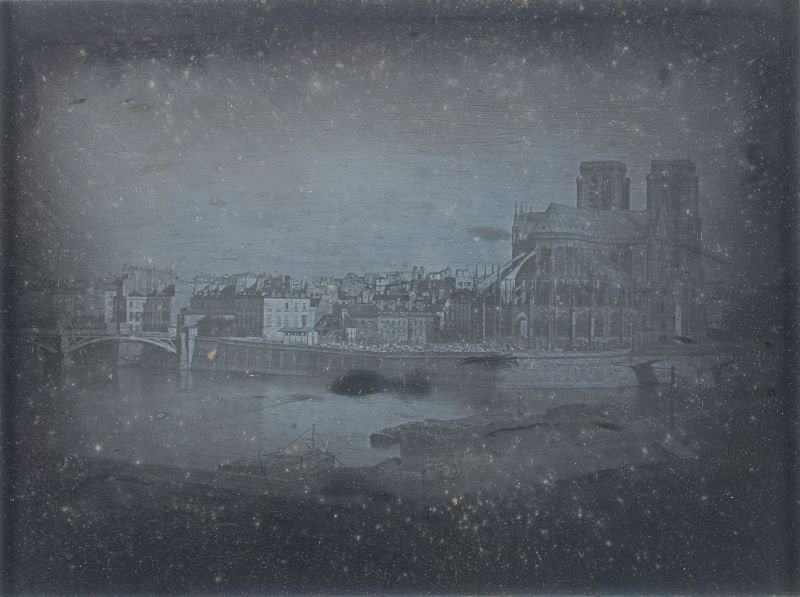
Daguerre lived an intricate and storied life, as we all do, however, the legacy of his work should be remembered, memorialized for the rest of time. If it were not for his ambition, I have no doubt that photography would still exist as an art, however, it may have looked entirely different to how we understand and appreciate it in this day and age. I hope that you have learned something today and that you have an excellent week!
Warmest regards,
Logan Clark
Works Cited
Alfred, Randy. “Aug. 19, 1839: Photography Goes Open Source.” WIRED, 19 August 2008, https://www.wired.com/2008/08/dayintech-0819/. Accessed 20 August 2024.
“Family tree of Louis DAGUERRE.” Geneastar, https://en.geneastar.org/genealogy/daguerrelou/louis-daguerre. Accessed 20 August 2024.
Habert, Judith. “Biography of Louis Daguerre, Inventor of Daguerreotype Photography.” ThoughtCo, 30 January 2020, https://www.thoughtco.com/louis-daguerre-daguerreotype-1991565. Accessed 20 August 2024.
“Isidore Niépce and Daguerre.” Nicéphore Niépce's House Museum, https://photo-museum.org/isidore-niepce-daguerre/. Accessed 20 August 2024.
“Louis Daguerre | daguerreotype, photography, inventor.” Britannica, 6 July 2024, https://www.britannica.com/biography/Louis-Daguerre. Accessed 20 August 2024.
“Louise Georgina Smith: Family Tree.” Geneanet.org, https://gw.geneanet.org/pierfit?lang=en&n=smith&oc=1&p=louise+georgina. Accessed 20 August 2024.
“Nicéphore Niépce, Daguerre and the Physautotype.” Nicéphore Niépce's House Museum, https://photo-museum.org/niepce-nicephore-daguerre-physautotype/. Accessed 20 August 2024.