
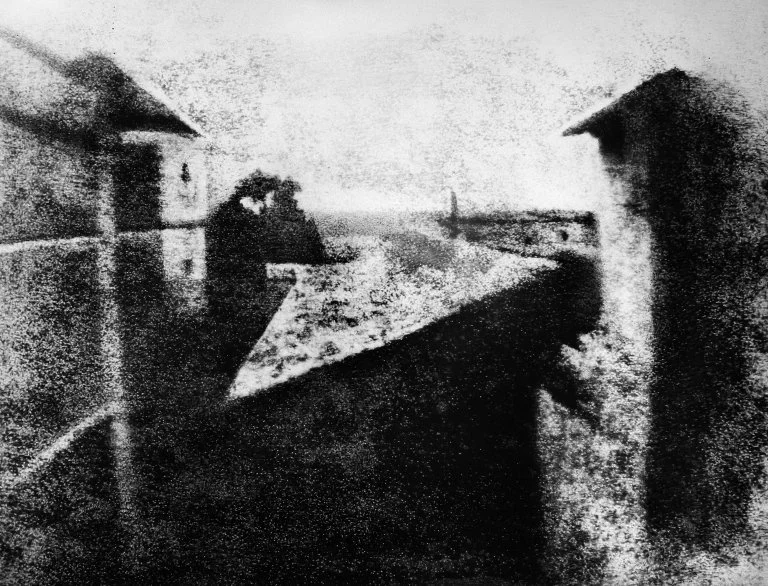
When people investigate the mysteries of history, I have to imagine the history of photography is usually the furthest from their minds. In spite of this, there is a rich history of photography that I think should be explored because that history has led myself and every other photographer to where we are today. With that in mind, I will be covering the pioneers of photography, starting with the first, Joseph Nicéphore Niépce.
Joseph Niépce was born on March 7, 1765, in the Kingdom of France. By age 24, he was forced away from his home due to the French Revolution. While away at university, he adopted the name of Nicéphore, out of reverence for St.Nicephorus, a 9th century Patriarch of Constantinople (Habert, 2020). Following his graduation with a degree in the studies of science, with special training in experimentation. Once he graduated, he returned to the university and became a professor (Habert, 2020).
Serving under the leadership of the legendary military strategist Napoleon, Niépce served the Kingdom of France as a staff officer. Unfortunately, due to falling ill, he was forced to resign from his post. While working as an administrator, in 1794, he married Agnes Romero during his time in Nice, eventually giving birth to a son, Isidore (Famous Person, 2018). By age 30, he resigned from an administrator position in the district of Nice, pursuing scientific research with his older brother, Claude (Habert, 2020).
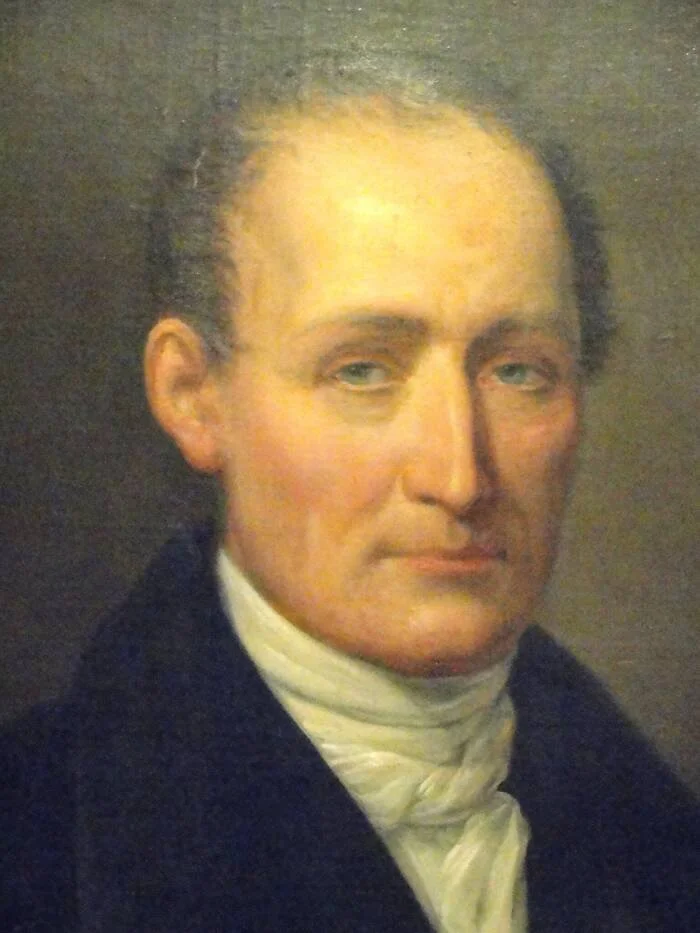
In 1816, he reportedly created a prototype of a photographic camera, using a portable camera obscura (Masoner, 2023). With that camera obscura, he exposed a pewter plate coated with bitumen to light (Masoner, 2023). Bitumen was an element that was a naturally occurring form of tar, harvested from the Dead Sea in Judea. It was also utilized by the Egyptians in the process of mummification (Photo Museum, 2015). In the 19th century, people already knew how to extract this tar from bituminous rocks (Photo Museum, 2015).
As he continued to develop his skills, he eventually photographed the first photographic ‘etching’ of Pope Pius VII in 1822, which once again utilized a camera obscura. In 1826, the revolutionary scientist developed the oldest surviving photograph. The photo was taken from a second-story window in France, experimenting for a number of days before finally capturing the first recorded photo to exist (Belden, 2024). Before it was known as photography, he referred to it as a heliograph. The term ‘heliograph’ was derived from the Greek words ‘helio’ and ‘graph’, which essentially means ‘sun writing’ (Belden, 2024).
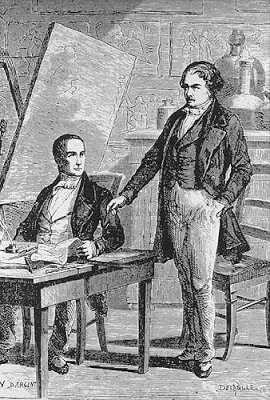
Writing about the process in December 1827, he acknowledged that the work was in need of additional work, but eventually deemed it as a first step in a new direction (Harry Ransom Center, 2024). Through his rigid experimentation, his work led to the innovation of photography, eventually working alongside Louis Jacques Mandé Daguerre to develop, what would eventually become the daguerreotype in 1837, defined as an image preserved as an object, or photograph, captured by an early photographic process (Habert, 2020).
Unfortunately, before the daguerreotype was fully developed, Niépce suffered a stroke and died on July 5th, 1833 at the age of 69. He was survived by his son, Isidore, who used his business acumen and his father’s teachings to form a partnership with Daguerre and was granted a government pension in 1839 in return for disclosing the technical details of Nicéphore's heliogravure process (Photo Museum, 2015).
Around June 2025, in what can only be described as the A.I. image generation boom, Niépce’s work was revisited through the lens of the artificial intelligence, placing his first still in the digital darkroom, in hopes to capture how that photo may have appeared were it to be taken in the modern day (Disotto, 2025) (Growcoot, 2025). However, according to numerous experts, those renditions were deemed to be wholly inaccurate, based on lighting, shadow placement, and additional factors. One reported professional made a point to give specific descriptions of the inaccuracies; “So the big triangle shape in the center is not another building or rooftop or any object — it was created by sunlight and shadows over the long exposure and is the courtyard area. There are two buildings on the right and left, that is clear. A tree in the distance. This was at his estate in La Gras, France (Growcoot, 2025).”
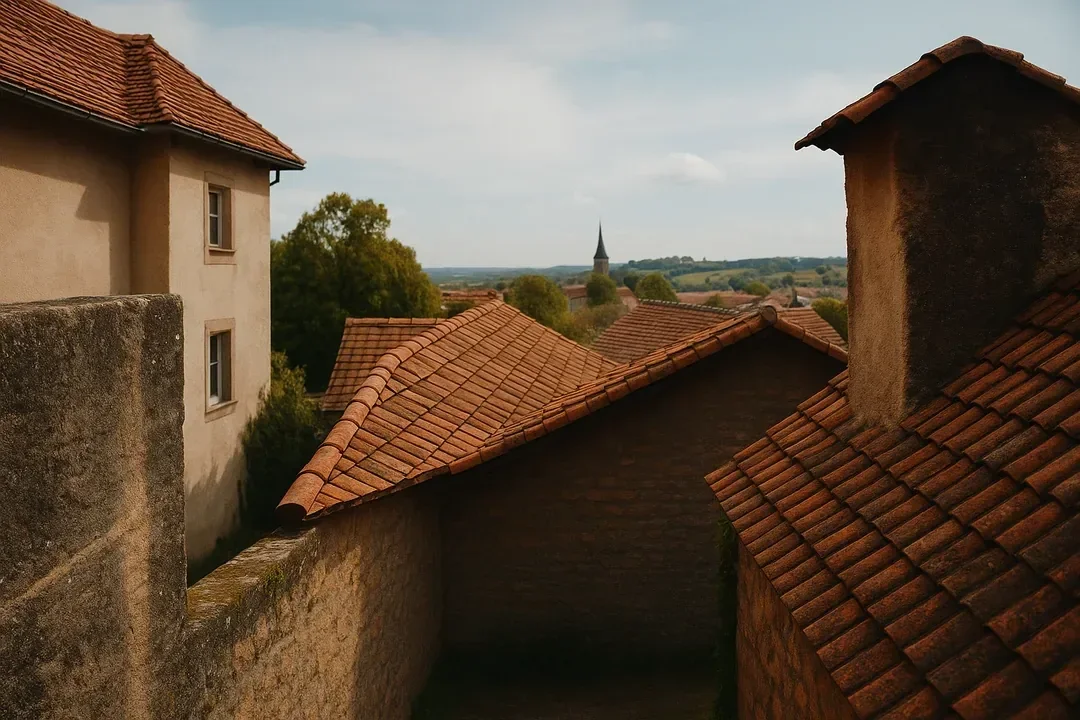
The A.I. rendition of Joseph Nicéphore Niépce’s original photograph, deemed inaccurate by professionals.
Considering the work was not a traditional photograph as we understand them in the modern context, but the original work of the heliograph, the entire perspective has to shift to an older model. A model that most of us have no frame of reference for, save for the few who have made that their field of study.
Joseph Nicéphore Niépce is memorialized as one of the pioneers of photography by way of his experiments that led to this seemingly fantastical discovery. Because of his work with heliography, we have the art form of photography today. Outside of photography, he had developed the pyréolophore, the first internal combustion engine, built a marly machine, which was a hydraulic machine that drew water to the Palace of Versailles, and made himself a vélocipède, an ancestor of the modern bicycle. Niépce was a polymath of his era, one who will and should be remembered through the rest of time. I hope you have learned something and that you have a great week!
All the best,
Logan Clark
Works Cited
Belden, Kris. “Joseph Nicéphore Niépce, View from the Window at Le Gras (article).” Khan Academy, https://www.khanacademy.org/humanities/becoming-modern/early-photo/early-photo-france/a/joseph-nicephore-niepce-view-from-the-window-at-le-gras. Accessed 15 July 2024.
Habert, Judith, and Mary Bellis. “Joseph Nicephor Niepce: The First Photographer.” ThoughtCo, 29 January 2020, https://www.thoughtco.com/joseph-niepce-the-first-photographer-2688371. Accessed 15 July 2024.
Masoner, Liz. “A Brief History of Photography and the Camera.” The Spruce Crafts, 6 July 2023, https://www.thesprucecrafts.com/brief-history-of-photography-2688527. Accessed 15 July 2024.
“Nicéphore Niépce Biography - Facts, Childhood, Family Life & Achievements of French Inventor & Photographer.” The Famous People, 24 April 2018, https://www.thefamouspeople.com/profiles/nicphore-nipce-31741.php. Accessed 15 July 2024.
“Niépce and the Invention of Photography.” Nicéphore Niépce's House Museum, 7 January 2015, https://photo-museum.org/niepce-invention-photography/. Accessed 15 July 2024.
“The Niépce Heliograph.” Harry Ransom Center, https://www.hrc.utexas.edu/niepce-heliograph/. Accessed 15 July 2024.
Disotto, John-Anthony. “This restoration of the world’s oldest photography shows the difference between AI slop and ChatGPT expertise.” Tech Radar, June 16, 2025. https://www.techradar.com/computing/artificial-intelligence/this-restoration-of-the-worlds-oldest-photograph-shows-the-difference-between-ai-slop-and-chatgpt-expertise. Accessed 21 October 2025.
Growcoot, Matt. “Reddit Asks ChatGPT to Restore World’s Oldest Photo and the Results are Horrible.” PetaPixel, June 17, 2025. https://petapixel.com/2025/06/17/reddit-asks-chatgpt-to-restore-worlds-oldest-photo-and-the-results-are-horrible/. Accessed 21 October 2025.