
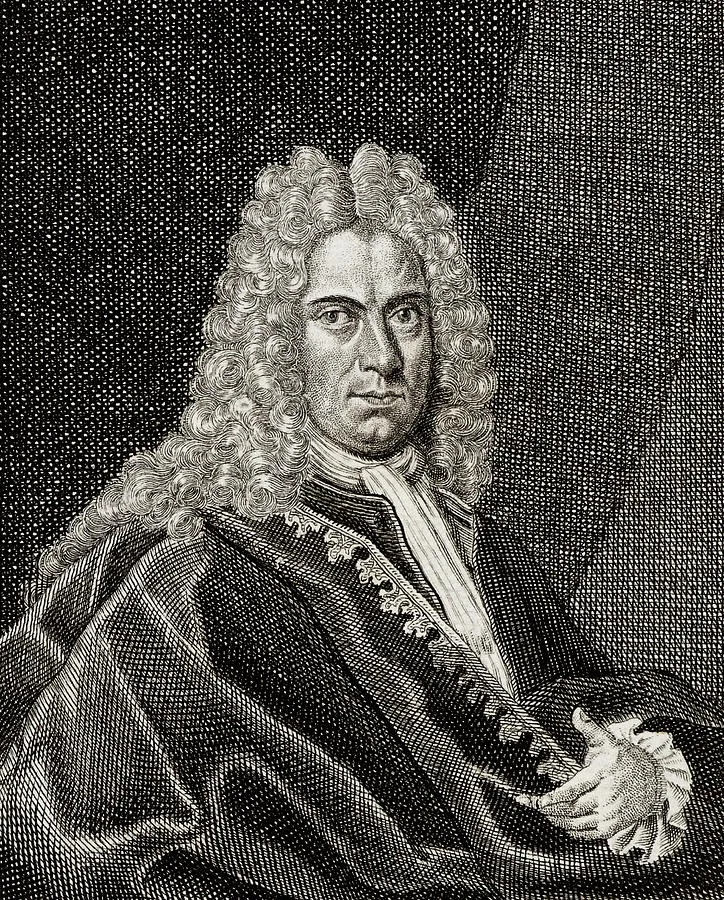
In my foray to research and uncover the history behind photography, I have discovered numerous men who have been deemed pioneers of the art form. As I have gone, I have covered the men who have been known to create and innovate the process we know as photography. However, there is an outlier in this history in Johann Heinrich Schulze; the precursor to photography.
Johann Heinrich Schulze was born in the Duchy of Magdeburg, a previous province which is now modern day Magdeburg, Germany, on May 12th, 1687. Unlike many of the pioneers I have discovered, essentially nothing is known about Schulze’s family history. Not much is known about what Schulze had done in his youth, but it is known that he was a polymath, primarily studying in the field of anatomy and becoming a professor in the field, as well as a professor in linguistics, specifically Arabic and Greek at the University of Altdorf and later became a professor of Eloquence and Antiquities at Halle (Litchfield, 1903). Additionally, he spent a great deal of time studying the fields of medicine, chemistry, philosophy, and theology, even managing to become a physician. He was even regarded as a historian of ancient medicine (Litchfield, 1903).
Schulze began the process of discovery, experimenting with silver nitrate. In this process, he discovered that silver nitrate was sensitive to light and that silver salts changed color in sunlight (Deutsches Museum, 2024). Specifically, he found that a slurry of chalk and nitric acid which silver had been dissolved into was darkened by sunlight, but not by exposure to heat, specifically from a fire. Further exploring for himself, he performed an experiment, which resulted in its darkening by light, applying stencils of words to a bottle filled with the mixture and placing it in direct sunlight, which produced copies of the text in dark characters on the surface of the contents. The impressions remained until the bottle was shaken or until prolonged exposure to light erased them. Because they were produced by the action of light, they have since been deemed to be similar to heliographs, a process which Nicéphore Niépce created a century later.
In 1719, Schulze published a memoir of his findings, highlighting the full process of his discoveries in the Transaction of Caesarean Academy (Litchfield, 1903). However, Schulze’s discovery was not a permanent image, as conveyed by the prolonged exposure or shaking of the bottle (Litchfield, 1903) (Watt, 2003). In his memoir, he reveals that the whole experiment began by reviewing German Alchemist Christian Adolf Balduin (Litchfield, 1903). Balduin had discovered a form of phosphorus in 1677, by use of silver nitrate, which Schulze described as “Balduin’s process” (Litchfield, 1903). As he attempted to replicate Balduin’s process, he stumbled upon his own discovery (Litchfield, 1903).
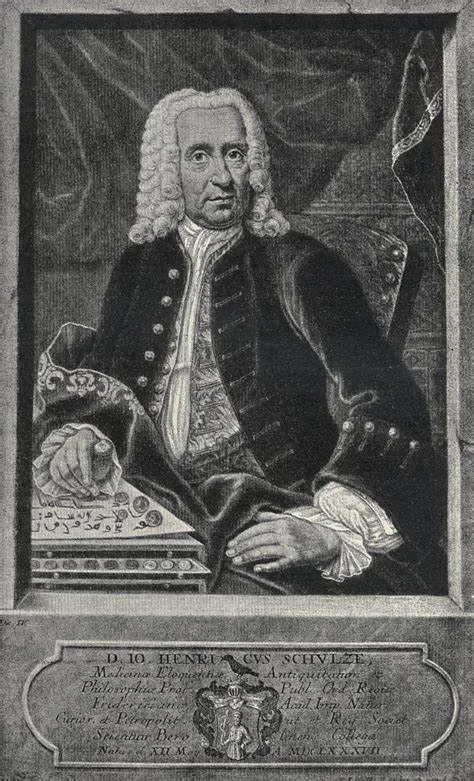
Schulze seemingly never truly uncovered the relevance of his discovery in the art of photography, although that would be investigated by many pioneers later in history. By 1800, Thomas Wedgwood would create a more firm process that had originated with Schulze’s experiments, however, managing to create permanent imagery. Similarly, Sir Humphry Davy had discovered a process that was similar to Wedgwood’s discovery. By 1826, Nicéphore Niépce created the first permanent image, a still of his local street from a second story apartment, thus marking him as the father of photography.
However Dr. Josef Maria Eder worked on a series of books between 1881 and 1932, known as Geschichte der Photographie, translated to mean History of Photography. In the process, he collaborated with Doctor C. Schiedel, whose entry was published in 1891. Between Eder and Schiedel’s contributions, the two affirmed the position that Schulze was the creator of modern photography (Litchfield, 1903). Richard Litchfield, a British scholar, believed that Schulze’s discovery was no doubt a scientific discovery, but noted that Schulze had given no indication of how we understand photography, accrediting Thomas Wedgwood as the creator of modern photography (Litchfield, 1903).
Throughout the rest of his life, Schulze was responsible for two substantial publications, the first being released in 1740, simply translated as Treatise on the Stone, a book covering internal medicines and the second being known as Chemische Versuche, translated as Chemical Tests, which was released in 1745, posthumously. On October 10, 1744, Schulze passed away, at the age of 57.
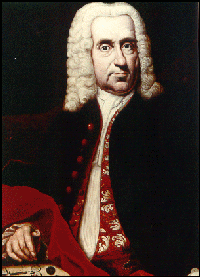
Schulze is undoubtedly a pioneer in the art of photography, regardless of whether he was aware of his discovery’s impact on the future. While he was relatively unknown throughout the duration of his life, his accomplishments were vast and broad, regardless of his photography discovery. The inventor created his legacy and should be remembered for his work. I hope that you have learned something today and that you have an excellent week.
Warmest regards,
Logan Clark
Works Cited
“In focus: the development of photography, film and television — Google Arts & Culture.” Google Arts & Culture, Deutsches Museum, https://artsandculture.google.com/story/in-focus-the-development-of-photography-film-and-television-deutsches-museum/EAWhqVxr8yRwJA?hl=en. Accessed 16 September 2024.
Litchfield, Richard Buckley. Tom Wedgwood, The First Photographer. Duckworth Books, 1903.
Watt, Susan. Silver. Benchmark Books, 2003.